While looking up Christaller and Von Thunen's theories (upon which Cronon relies heavily in his book Nature's Metropolis), I came across this critique by Brian Page and Richard Walker, entitled "Nature's Metropolis: The Ghost Dance of Christaller and Von Thunen." The paper asserts that these views are outdated and limiting, and that Cronon underestimates the effects of agents such as "conquest, industrial production, agriculture and capital accumulation" in his exploration of geographic expansion.
Here is the link:
http://oldweb.geog.berkeley.edu/PeopleHistory/faculty/R_Walker/Walker_53.pdf
Showing posts with label Cronon. Show all posts
Showing posts with label Cronon. Show all posts
Tuesday, July 2, 2013

Friday, February 18, 2011
The trouble with the trouble with wilderness
Bill Cronon's "The trouble with wilderness" is one of the most widely read essays in the field of environmental history. You might want to check out some of the responses it spurred. Here is a link to one, "The trouble with Bill Cronon's wilderness," by Samuel Hays:
http://www.jstor.org/stable/3985060
But remember, the precis assignment does not include personal opinions--only a summary of Cronon's piece.
http://www.jstor.org/stable/3985060
But remember, the precis assignment does not include personal opinions--only a summary of Cronon's piece.
Monday, February 9, 2009
Schizophrenic America
I really enjoyed William Cronon's "The Trouble with Wilderness." I think he truly captured the duality that exists when it comes to perceptions of the wilderness, both within the environmental community and in America at large. Lowenthal spoke of American dislike for nostalgia and the past. Early Americans, after all, came to the new world to be "reborn" (so to speak) and make their own mark on history, unencumbered by their European ancestry. The same can be said for immigrants in the early 20th century who came to the US to escape religious persecution, blight, starvation and other forms of suffering in order to make new lives for themselves. Yet despite the freedom that America and the wilderness have come to represent, the very idea of primitivism, returning to nature and the simpler things in life, contradicts this very notion. Thoreau and others have used the wild to reinvent themselves. Their journey into nature was a way to discover the bare essentials that made them human, the very roots of humanity. Our obsession with the past doesn't stop at nature. Just look at the entertainment industry. How many films in recent years have been period pieces? There are more revivals on Broadway than there are fresh new plays. Even the fashion industry is looking towards the past to pave the way for next season's styles. Our vision of wilderness is just as romantic as it is idealistic. We see it as both a place to escape "history and the obligation to take responsibility for our own actions" and somewhere to reminisce about the ol' frontier and commiserate about the problems of modern life. Cronon describes our bipolar attitude with compassion and insight, and suggests the only way to reconcile the two is to invite the wilderness into our world instead of making the journey into it.
Wednesday, February 20, 2008
ZARDOZ!
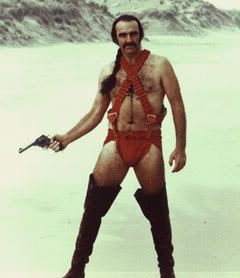 When reading that Cronon essay for the 10th time the other night I was struck by the passage about the model frontiersman being hypermasculine. The image I had fought so hard to bury - a young Sean Connery wearing little more than thigh-high boots and a weird red leotard - came to me. Yes, my friends, I have come here to discuss one of the greatest films ever made - John Boorman's Zardoz.
 While Zardoz is far from the perfect allegory for "Getting Back to the Wrong Nature", it is chock full of colorful illustrations of problems that arise from the wilderness concept Cronon urges us to drop. Actually, the film is so outlandish that you could probably put any kind of spin on it (paper topic alert), but on to my point. Two distinct classes exist in the post-apocalyptic setting of Zardoz - a small group of feminine, super intelligent and immortal beings with telepathic powers (Eternals), and the barbaric race of men who populate the Earth.
The Eternals are an exaggerated picture of the upper echelons of our society. On the one hand they entertain one another with telepathic banter and hold quaint meetings to work through the issues in their community. On the other hand they seem to be completely detached when it comes to exploiting the Sean Connery's of Earth to get their food (the Eternals are vegetarians). They even go so far as to recruit a subset of 'brutes' whose sole purpose is to keep their own population size in check.
Though they live in luxury and have cool powers, the Eternals can't help but be sad about having to live forever. Fortunately, things get shaken up when Sean Connery finds a way to enter their world. The Eternals discover that this brute is far more complex than they originally presumed.
I have probably already said too much. This is a must see movie and I don't want to ruin it for you. I'm getting together with another ntres232 person to watch it this Friday or Saturday and you are welcome to join us.
A trailer:
Subscribe to:
Posts (Atom)

 Posts
Posts

