Friday, February 29, 2008

Tantillo's "train wreck" lecture on Thoreau


Here's the full quote from Thoreau's Walden that I botched today in lecture. If anyone is interested in the theme of excrementitious scatology that I mentioned, here is a citation to a fun article to read:

West, Michael. "Scatology and Eschatology: The Heroic Dimensions of Thoreau's Wordplay." Proceedings of the Modern Language Association 89 (1974): 1043-64.

Never too early. Enjoy.

Thoreau writes:
Few phenomena gave me more delight than to observe the forms which thawing sand and clay assume in flowing down the sides of a deep cut on the railroad through which I passed on my way to the village, a phenomenon not very common on so large a scale, though the number of freshly exposed banks of the right material must have been greatly multiplied since railroads were invented. The material was sand of every degree of fineness and of various rich colors, commonly mixed with a little clay. When the frost comes out in the spring, and even in a thawing day in the winter, the sand begins to flow down the slopes like lava, sometimes bursting out through the snow and overflowing it where no sand was to be seen before. Innumerable little streams overlap and interlace one with another, exhibiting a sort of hybrid product, which obeys half way the law of currents, and half way that of vegetation. As it flows it takes the forms of sappy leaves or vines, making heaps of pulpy sprays a foot or more in depth, and resembling, as you look down on them, the laciniated, lobed, and imbricated thalluses of some lichens; or you are reminded of coral, of leopard's paws or birds' feet, of brains or lungs or bowels, and excrements of all kinds. It is a truly grotesque vegetation . . . .

Summer program

NTU are holding an International summer program from June 13-July 6, 2008. Students from the US (University of Illinois and others), Asia countries and NTU will attend this program. During the 22 days course, we will visit three National Parks (Yangmingshan, Taroko, and Yushan), NTU Experimental Forest in Chitou and Heshe, NTU Experimental Farm in Meifeng, Fu-Shan Research Station, Taiwan Forest Research Institute, Guandu Nature Park, Yeliou Geo-park, Taipei Zoo and King Car Orchid Park etc. Basically we will bring the students from the ocean to low, mid, and high elevation, where students will see why and how an island as small could be endowed with such high biodiversity. We’ll also arrange for students to visit the world famous National Palace Museum, to get hands-on experiences with the bamboo and tea culture, as well as the Chinese calligraphy and language. Students will have taste of the Taiwanese delicacies and even the chance to make some themselves! For all the courses and activities, each student only need to pay their airplane tickets and living expenses in Taiwan (US$1,500), and NTU will cover the tuition (about another US$1,500). We really think this is a great opportunity for your students to gain international experiences and learn sub-tropical biodiversity. Please let as many your students know this program as possible and please see the program web for more information. http://bc.zo.ntu.edu.tw/BAC%20summer%20program/index.html Forget to mention that if there is student really interested in this program but would like have scholarship support, we can find some Cornell Alumni form Taiwan to pay partial living expenses in Taiwan.
Would you please also forward this email to the Dean of Ag. and other professors or students who might be interested in this program?

Thursday, February 28, 2008

Mrs. O'Leary's Cow . . .

. . . turns out to be innocent. Wikipedia as sometimes occurs has the straight scoop. The newsman who first reported the cow explanation later admitted he made the story up.

Other theories abound--including one about a comet breaking up and starting multiple fires on the same day.

Mrs. Catherine O'Leary Milking Daisy
Norman Rockwell, ca. 1935

William Gilpin the Booster

Here's a page from UVA about another William Gilpin, the booster Cronon talks about that was such a fan of the strange Isothermal Zodiac theory... I thought the whole booster phenomenon and the idea of people trying to convince investors, etc. that their city was "destined" to be great was really interesting. What would have happened to Chicago if it weren't for such people? Cronon describes the issues with the water transportation, the flooding, and other seasonal issues. One has to wonder if people would have stuck it out long enough for Chicago to become a center for commerce if it had not been for the boosters.

http://xroads.virginia.edu/~hyper/HNS/chapter3.html

Wednesday, February 27, 2008

Back to Disney

As noted in previous posts, Disney pictures released some of the most influential films of our generation. While reading The Ecological Indian, I couldn't help but remember a Disney movie that noted the environmental lifestyle of Native Americans before Colonizers: Pocahontas. Could this movie potentially have influenced our perception of nature and Indians by hardcoding its scenes and soundtracks into our youthful minds?

Remember back to your earlier days and I'm sure that you've probably hummed "Colors of the Wind" or at least cursed it for getting stuck in your head at least once. In Pocahontas, Native Americans were portrayed as the link between nature (the colors of the wind, land, willow trees, rivers, and pesky raccoons) and mankind (John Smith and his band of European colonizers). Pocahontas seemed to have made herself one with the earth and all of its elements, learning to live in harmony with nature and wilderness. By befriending not only the animals but also the trees, Disney asserts that Indians intracted with nature in a peaceful manner. Through the songs "Just around the Riverbend" and "Colors of the Wind", Disney asserted that the Indians knew their environment so intricately that there was little that kept them from merely dissolving into the earth and being swept away in the wind. Though the principal theme of Pocahontas was the romance between her and John Smith, the clash of two cultures and ultimately the tale of Pocahontas, one cannot deny its powerful statement about the realtionship between Indians and their environment.

So, one can only ponder, why haven't we watched Pocahontas in class yet?

Monday, February 25, 2008

Ideas on buffalo population decimation...

In an attempt to see what the public’s general response to The Ecological Indian was when Krech’s book first came out, as we were talking about today, I came across this article from 1999 which outlines some less familiar explanations for the sharp decline of buffalo on the plains. Instead of focusing on the white man’s decimation of buffalo populations, the article points out that this was probably just the icing on the cake; that the primary factors in their decline included not only what Krech brought up with Indians being involved in the buffalo trading market, but also climate change, competition for food resources, and disease. This is an interesting article to look at in terms of deflating the myth that the Europeans came in and singlehandedly destroyed the buffalo population.


The link:

http://query.nytimes.com/gst/fullpage.html?res=9501EFD6123DF935A25752C1A96F958260&sec=&spon=

Saturday, February 23, 2008

Art as Sorrow/Pain

When we were discussing nature as sublime in class on Friday, I was reminded of a quote I once heard about art/nature/beautiful things. I can't remember it exactly but it said something to the effect of: art or other beautiful things (like sunsets, mountain views, etc.) are painful because you want to grasp those moments forever, but you can't. I just really liked that way of thinking about it because I do get some sort of feeling of sorrow or something when I see a beautiful sunset, or a painting that I wish I could stare at for hours. Not quite the same thing as the 'sublime' which is sort of joy and terror mixed together but similar - kind of a mix of joy and nostalgia. Anyway, just something that came to mind.

Friday, February 22, 2008

Gilpin and the picturesque

Hey gang,
when in doubt, Wikipedia to the rescue for the basics. Here's an excerpt from the entry on William Gilpin:

In 1768 Gilpin published his popular Essay on Prints where he defined the picturesque as '"that kind of beauty which is agreeable in a picture" and began to expound his "principles of picturesque beauty", based largely on his knowledge of landscape painting. During the late 1760s and 1770s Gilpin travelled extensively in the summer holidays and applied these principles to the landscapes he saw, committing his thoughts and spontaneous sketches to notebooks. . . .

For Gilpin, both texture and composition were important in a "correctly picturesque" scene. The texture should be "rough", "intricate", "varied", or "broken", without obvious straight lines. The composition should work as a unified whole, incorporating several elements: a dark "foreground" with a "front screen" or "side screens", a brighter middle "distance", and at least one further, less distinctly depicted, "distance". A ruined abbey or castle would add "consequence". A low viewpoint, which tended to emphasise the "sublime", was always preferable to a prospect from on high. While Gilpin allowed that nature was good at producing textures and colours, it was rarely capable of creating the perfect composition. Some extra help from the artist, perhaps in the form of a carefully placed tree, was usually required. . . .

Although he came in for criticism, Gilpin had published at the exactly the right time. Improved road communications and travel restrictions on continental Europe saw an explosion of British domestic tourism in the 1780s and 1790s. Many of these picturesque tourists were intent on sketching, or at least discussing what they saw in terms of landscape painting. Gilpin's works were the ideal companions for this new generation of travellers; they were written specifically for that market and never intended as comprehensive travel guides.

The influence of Gilpin and Burke on subsequent philosophizing about landscape probably can't be emphasized enough. Another great topic!

BANFF Mountain Film Festival

Cornell is hosting the BANFF Mountain Film Festival tonight (2/22):

http://www.coe.cornell.edu/goto.jsp?page=news.banff.2007.videos


Here is one of the films being featured:

La Ventana Venezuela, 2007, 21 minutes Directed and produced by Federico Pisani Focus: Mountaineering Rating: General
The landscape in Patagonia is breathtaking, and so is its bad weather. In this film, a group of Venezuelans are determined to write their own story on Cerro Torre and St. Exupery, beautiful and icy giants of granite. But only the winds decide when. Patience and motivation are essential in order to endure the harsh conditions. Sometimes, the mountains show themselves in their best light and allow us to visit this vertical and forbidden world.


How's that for an "operatic" depiction of landscape?

WWID? (what would the Indian's do?)

here's a link I found for a review of Krech's Ecological Indian. From the perspective of an Indian.

http://www.iiirm.org/publications/Book%20Reviews/Reviews/Krech001.pdf

Wednesday, February 20, 2008

ZARDOZ!

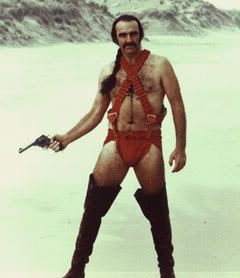
When reading that Cronon essay for the 10th time the other night I was struck by the passage about the model frontiersman being hypermasculine. The image I had fought so hard to bury - a young Sean Connery wearing little more than thigh-high boots and a weird red leotard - came to me. Yes, my friends, I have come here to discuss one of the greatest films ever made - John Boorman's Zardoz.

While Zardoz is far from the perfect allegory for "Getting Back to the Wrong Nature", it is chock full of colorful illustrations of problems that arise from the wilderness concept Cronon urges us to drop. Actually, the film is so outlandish that you could probably put any kind of spin on it (paper topic alert), but on to my point. Two distinct classes exist in the post-apocalyptic setting of Zardoz - a small group of feminine, super intelligent and immortal beings with telepathic powers (Eternals), and the barbaric race of men who populate the Earth.

The Eternals are an exaggerated picture of the upper echelons of our society. On the one hand they entertain one another with telepathic banter and hold quaint meetings to work through the issues in their community. On the other hand they seem to be completely detached when it comes to exploiting the Sean Connery's of Earth to get their food (the Eternals are vegetarians). They even go so far as to recruit a subset of 'brutes' whose sole purpose is to keep their own population size in check.

Though they live in luxury and have cool powers, the Eternals can't help but be sad about having to live forever. Fortunately, things get shaken up when Sean Connery finds a way to enter their world. The Eternals discover that this brute is far more complex than they originally presumed.

I have probably already said too much. This is a must see movie and I don't want to ruin it for you. I'm getting together with another ntres232 person to watch it this Friday or Saturday and you are welcome to join us.

A trailer:

"Man" - Nature themes in Planet of the Apes

Hi everyone,
we mentioned Planet of the Apes in class this week, and there is a lot of potential there for an interesting term project for the course.

I alluded to the famous final scene of the movie (1968), where Charlton Heston discovers the Statue of Liberty and realizes he's been home all along. Great, great stuff.


This clip is of that final scene. Enjoy.

Tuesday, February 19, 2008

Cronon-bashing

Hey guys,

Check out this critique of Cronon's "The Trouble with Wilderness," written by "Guy Tal" on the Essential Landscape Web Journal:

http://scenicwild.com/serendipity/index.php?/archives/29-Why-William-Cronon-Doesnt-Understand-Wilderness.html

Anyone able to give a critique of his critique???


" Why William Cronon doesn't understand wilderness:

Someone recently sent me a link to a belabored diatribe titled "The Trouble with Wilderness; or, Getting Back to the Wrong Nature" by Professor William Cronon of the University of Wisconsin. It was an enlightening read.Other than starting the article by failing to note or articulate the difference between Wilderness and Wildness (and thus completely missing the essence of the famous quote from Henry David Thoreau), Cronon's idea of Wilderness somehow manages to be out of touch with every single formal definition of the term, whether legal or common. His bombastic title and lengthy analysis all seem to revolve around the unfounded perception that wilderness advocates promote a notion that "the human is entirely outside the natural." This premise is patently false. No definition of the term excludes human presence or experience from the natural world. If anything, wilderness is defined by its relation to humans, and by excluding certain human constructs and activities, but never humans presence. The Wilderness Act of 1964 defines wilderness as an area "untrammeled by man", rather than an area where man has no presence or stake or experience.

To claim that wilderness excludes all human experience is like claiming that virginity excludes any romantic interlude between lovers, rather than very specific physical acts. It's like claiming that criminal laws excludes all freedoms, rather than specific deeds deemed to be harmful to society. It is, in essence, a gross mischaracterization, and false representation of what the term means to most of those who espouse it.

For such a contentious title, one would think a conclusion will be pretty self-evident, and yet you would have to look pretty hard to find out exactly what Cronon thinks "the trouble" actually is: "a flight from history" (really?), "an escape from responsibility" (huh?). In a way it seems he is trying to construct a fictitious point only to triumphantly tear it down and claim it is false. Wilderness activists are not trying to escape from responsibility - if anything they are trying to assert responsibility. They are pointing out all the spiritual and ecological values of restraining industrialization and sprawl so that the historic account of human-induced devastation serves as a lesson rather than something to ignore or escape. How easy it is to twist words and meanings to "prove" a point.

While searching through the article for "the trouble with wilderness" you may actually discover some trouble with religious beliefs, politics, racism, and a number of other far more blatantly flawed human perceptions than the modern idea of wilderness.

Would one not expect an educated analysis to begin with a clear and commonly-accepted definition and understanding of a concept before attempting to show "trouble" with it?

The Wilderness Society, founded by Aldo Leopold defines its mission in a single line:

"Deliver to future generations an unspoiled legacy of wild places, with all the precious values they hold: Biological diversity; clean air and water; towering forests, rushing rivers, and sage-sweet, silent deserts."

Read it again: deliver to future generations... they do mean generations of humans! Where exactly does Cronon get such warped perceptions as "a crude conflict between the “human” and the “nonhuman”"?

In my mind it was Edward Abbey that framed the real trouble with wilderness:

"The idea of wilderness needs no defense. It only needs more defenders." "


LM Note:

“Untrammeled. A key descriptor of wilderness in the Wilderness Act, untrammeled refers to the freedom of a landscape from the human attempt to intervene, alter, control, or manipulate natural conditions or processes to provide particular benefits.” — FWS Draft Wilderness Stewardship Policy, 2001

Deer population control at Cornell

February 19th's issue of the Cornell Daily Sun had an article about the methods in which Cornell will attempt to curb its deer population. I have no problem with taking measures to control deer populations for ecological reasons, since humans have eliminated their natural predators and overpopulated deer can overgraze and alter the natural habitat. However, I do have a problem with the motives this article listed for Cornell's deer control program: deer-vehicle accidents and damage to crops, ornaments, the Arboretum and Botantical Gadens, and research plots. I believe that limiting deer-vehicle accidents is a more serious factor than the other motives listed in the article, but it is still mostly a superficial motive for curbing the deer population because deer are usually to small to harm a person in a collision, they usually just damage the car. The article also said that that Cornell fences was considering putting errecting 8 foot tall fences arround the core of the campus. These fences would be much more of an eyesore than the eyesore of whatever landscaping or "ornamental damage" the deer might cause. Furthermore, I would gladly sacrifice seeing some obscure plant in the Botanical Gardens, that the deer would eat, to spot a deer there instead. As I said before, I am not opposed to controlling Cornell's deer population, but I am opposed to the superficial motives for controlling the population listed in this article.

The article is titled Program Aims to Limit Number of Deer and is written by Alix Dorfman.

The Trouble with Enivronmentalists

The other day I was having a conversation with an Economics major who was becoming interested in environmental careers. I encouraged him, noting all the important things someone with a background in economics could do to help people and the environment. He was happy to hear this and explained that he used to think of environmentalists simply as people with protest signs who chained themselves to trees and tried to preserve remote ideals. (My mind immediately went to the spotted-owl controversy.)
I have encountered this view of environmentalism on more than one occasion and I think that William Cronin, in 'The Trouble with Wilderness' really helps to explain why this is not the proper way to approach environmentalism. Personally, I believe human suffering should be addressed before anything. But it is in maintaining a healthy planet that we can best alleviate and prevent suffering. As Cronin points out - we are part of nature. Agriculture, pollution, and disease are all environmental issues that directly affect humans. However in my view, conservation is equally important. And while the latter issues tend to be politically popular to address, conservation seems to be met with more resistance. I argue that conservation is just as much a human-related issue as pollution, disease, etc. As Cronin notes, life will go on, with or without us. Conservation is about protecting the planet in a state where humans can flourish - a state most likely similar to that in which humans evolved, which includes lots of 'natural' land to recycle our wastes and provide us with food and clean air. Thus environmentalists, including conservationists, are not simply tree hugging protesters (not to say I don't hug trees from time to time); to me, environmentalists are people who are concerned about people and importantly, humanity's future

Monday, February 18, 2008

The Course of Empire

The Course of Empire--Destruction

Hi everyone,
The entry for Cole's The Course of Empire at Wikipedia is surprisingly decent--plus the five paintings of the series are each reproduced digitally with good resolution jpegs. Enjoy.
jt

Sunday, February 17, 2008

Hunting rituals

As I read The Ecological Indian: Myth and History - more specifically the chapter on Buffalo - I cannot help but notice similarities between certain hunting rituals performed by Plains Indians, and by English royalty or nobles back in medieval times. For example, Krech mentions that Euro-Americans were disgusted to witness Indians " 'devouring the meat still warm with life' " and disturbed by the " ' savage scene' " of Indians smearing buffalo blood all over their faces. The Euro-Americans feelings of disgust (and maybe of superiority over these "savages") are sort of amusing to me, especially when remembering things we've read about English hunting rituals: the presentation of fresh deer droppings to the queen, the opening of the fresh deer carcass to cut out and distribute certain organs to certain people, the dipping of bread into the carcass to soak it with blood before eating it, and even how royal ladies would cover their hands and faces with deer blood, because they thought it was great for their complexion.

Friday, February 15, 2008

Spirited Away: River God

Near the end of class, Hayao Miyazaki's film "Princess Mononoke" was discussed for some time. I also wanted to bring attention to another Miyazaki film that incorporates the idea of humans having a negative impact on the environment. This film is "Spirited Away", and just to give people some background, the main character is a girl named Chihiro who enters a spirit world. She ends up working in a bath place, where she encounters the suffering river god:

http://youtube.com/watch?v=14FXLHMTNF4

This is how Wikipedia explains the river spirit:
River Spirit (川の神 kawa no kami)
A customer of the bathhouse originally thought to be a "stink spirit" who is assigned to Chihiro and Lin. Yubaba suspects that he may be something more than a stink spirit; when Chihiro helps him by pulling trash that had been dumped into his river out of his side (Miyazaki had a strong interest in the environments and wished to portray the destruction of rivers), her suspicions are proven correct. He is in fact a famous and wealthy river god. As a reward for cleaning him, he gives Chihiro a ball of plant material which, viewers are told by Kamajii in the English-subtitled version, is a "healing cake". In the English dubbed version, Kamajii simply states that it is medicine from the river god. The "healing cake" is later used to heal an injured Haku through ingestion and to cause No Face to vomit the people and vast amounts of food he ate during his rampage. It is implied that the taste of it is extremely bitter, as demonstrated when Chihiro tries a bite and reacts violently.

Thursday, February 14, 2008

A Refreshing Walk

I was curious to see what other people thought of the Thoreau article this week - "Walking". I had mixed reactions to it. On the one hand, Thoreau clearly goes overboard at some points and says things that he probable doesn't actually mean. For example, on page 196 he says "A successful life knows no law," a little extreme if you ask me. But overall I really liked the article. Extreme or not, it helps to remind the reader of things he or she may forget from time to time. Nature truly can be a place to clear the mind and embrace a more uninhibited side of ourselves. He reminds us of the importance of leaving the working world behind from time to time and simply venturing into the great outdoors, however much of a struggle it may be to forget our worries. Interestingly, he even calls nature a "sacred place" on page 182, which is reminiscent of the Greek and Roman approach to wilderness. He also connects nature to freedom and purity and talks extensively about his yearning to go westward, to follow the future. Unfortunately I think this perspective can be and was used to encourage the fulfillment Manifest Destiny and inspired in some people a desire to conquer nature rather than live peacefully with it. In spite of the possibility of misinterpretation, I think the article on the whole is a worthwhile reminder that an occasional foray into nature can offer the mind repose and clarity and can rejuvenate a person's sense of 'wildness'.

Wednesday, February 13, 2008

The history of Smokey Bear


While perusing the internet, I came across the banner advertisement on the left. I felt the ad was prophetic enough, so I journeyed over to www.smokeybear.com and looked through the history of this iconic legend. As it turns out, the original 'fire prevention campaign' was waged with the assistance of Disney's Bambi. The campaign was allowed to use the image of a fawn for a year; however they had learned how effective an animal mascot could be for getting information to the public. Later that year, Smokey Bear was created, and from that day in 1944 until now,

'Only you can prevent wildfires.'

Here's the informational link:

http://www.smokeybear.com/vault/bambi_bear.asp