Friday, February 29, 2008

Tantillo's "train wreck" lecture on Thoreau


Here's the full quote from Thoreau's Walden that I botched today in lecture. If anyone is interested in the theme of excrementitious scatology that I mentioned, here is a citation to a fun article to read:

West, Michael. "Scatology and Eschatology: The Heroic Dimensions of Thoreau's Wordplay." Proceedings of the Modern Language Association 89 (1974): 1043-64.

Never too early. Enjoy.

Thoreau writes:
Few phenomena gave me more delight than to observe the forms which thawing sand and clay assume in flowing down the sides of a deep cut on the railroad through which I passed on my way to the village, a phenomenon not very common on so large a scale, though the number of freshly exposed banks of the right material must have been greatly multiplied since railroads were invented. The material was sand of every degree of fineness and of various rich colors, commonly mixed with a little clay. When the frost comes out in the spring, and even in a thawing day in the winter, the sand begins to flow down the slopes like lava, sometimes bursting out through the snow and overflowing it where no sand was to be seen before. Innumerable little streams overlap and interlace one with another, exhibiting a sort of hybrid product, which obeys half way the law of currents, and half way that of vegetation. As it flows it takes the forms of sappy leaves or vines, making heaps of pulpy sprays a foot or more in depth, and resembling, as you look down on them, the laciniated, lobed, and imbricated thalluses of some lichens; or you are reminded of coral, of leopard's paws or birds' feet, of brains or lungs or bowels, and excrements of all kinds. It is a truly grotesque vegetation . . . .

Summer program

NTU are holding an International summer program from June 13-July 6, 2008. Students from the US (University of Illinois and others), Asia countries and NTU will attend this program. During the 22 days course, we will visit three National Parks (Yangmingshan, Taroko, and Yushan), NTU Experimental Forest in Chitou and Heshe, NTU Experimental Farm in Meifeng, Fu-Shan Research Station, Taiwan Forest Research Institute, Guandu Nature Park, Yeliou Geo-park, Taipei Zoo and King Car Orchid Park etc. Basically we will bring the students from the ocean to low, mid, and high elevation, where students will see why and how an island as small could be endowed with such high biodiversity. We’ll also arrange for students to visit the world famous National Palace Museum, to get hands-on experiences with the bamboo and tea culture, as well as the Chinese calligraphy and language. Students will have taste of the Taiwanese delicacies and even the chance to make some themselves! For all the courses and activities, each student only need to pay their airplane tickets and living expenses in Taiwan (US$1,500), and NTU will cover the tuition (about another US$1,500). We really think this is a great opportunity for your students to gain international experiences and learn sub-tropical biodiversity. Please let as many your students know this program as possible and please see the program web for more information. http://bc.zo.ntu.edu.tw/BAC%20summer%20program/index.html Forget to mention that if there is student really interested in this program but would like have scholarship support, we can find some Cornell Alumni form Taiwan to pay partial living expenses in Taiwan.
Would you please also forward this email to the Dean of Ag. and other professors or students who might be interested in this program?

Thursday, February 28, 2008

Mrs. O'Leary's Cow . . .

. . . turns out to be innocent. Wikipedia as sometimes occurs has the straight scoop. The newsman who first reported the cow explanation later admitted he made the story up.

Other theories abound--including one about a comet breaking up and starting multiple fires on the same day.

Mrs. Catherine O'Leary Milking Daisy
Norman Rockwell, ca. 1935

William Gilpin the Booster

Here's a page from UVA about another William Gilpin, the booster Cronon talks about that was such a fan of the strange Isothermal Zodiac theory... I thought the whole booster phenomenon and the idea of people trying to convince investors, etc. that their city was "destined" to be great was really interesting. What would have happened to Chicago if it weren't for such people? Cronon describes the issues with the water transportation, the flooding, and other seasonal issues. One has to wonder if people would have stuck it out long enough for Chicago to become a center for commerce if it had not been for the boosters.

http://xroads.virginia.edu/~hyper/HNS/chapter3.html

Wednesday, February 27, 2008

Back to Disney

As noted in previous posts, Disney pictures released some of the most influential films of our generation. While reading The Ecological Indian, I couldn't help but remember a Disney movie that noted the environmental lifestyle of Native Americans before Colonizers: Pocahontas. Could this movie potentially have influenced our perception of nature and Indians by hardcoding its scenes and soundtracks into our youthful minds?

Remember back to your earlier days and I'm sure that you've probably hummed "Colors of the Wind" or at least cursed it for getting stuck in your head at least once. In Pocahontas, Native Americans were portrayed as the link between nature (the colors of the wind, land, willow trees, rivers, and pesky raccoons) and mankind (John Smith and his band of European colonizers). Pocahontas seemed to have made herself one with the earth and all of its elements, learning to live in harmony with nature and wilderness. By befriending not only the animals but also the trees, Disney asserts that Indians intracted with nature in a peaceful manner. Through the songs "Just around the Riverbend" and "Colors of the Wind", Disney asserted that the Indians knew their environment so intricately that there was little that kept them from merely dissolving into the earth and being swept away in the wind. Though the principal theme of Pocahontas was the romance between her and John Smith, the clash of two cultures and ultimately the tale of Pocahontas, one cannot deny its powerful statement about the realtionship between Indians and their environment.

So, one can only ponder, why haven't we watched Pocahontas in class yet?

Monday, February 25, 2008

Ideas on buffalo population decimation...

In an attempt to see what the public’s general response to The Ecological Indian was when Krech’s book first came out, as we were talking about today, I came across this article from 1999 which outlines some less familiar explanations for the sharp decline of buffalo on the plains. Instead of focusing on the white man’s decimation of buffalo populations, the article points out that this was probably just the icing on the cake; that the primary factors in their decline included not only what Krech brought up with Indians being involved in the buffalo trading market, but also climate change, competition for food resources, and disease. This is an interesting article to look at in terms of deflating the myth that the Europeans came in and singlehandedly destroyed the buffalo population.


The link:

http://query.nytimes.com/gst/fullpage.html?res=9501EFD6123DF935A25752C1A96F958260&sec=&spon=

Saturday, February 23, 2008

Art as Sorrow/Pain

When we were discussing nature as sublime in class on Friday, I was reminded of a quote I once heard about art/nature/beautiful things. I can't remember it exactly but it said something to the effect of: art or other beautiful things (like sunsets, mountain views, etc.) are painful because you want to grasp those moments forever, but you can't. I just really liked that way of thinking about it because I do get some sort of feeling of sorrow or something when I see a beautiful sunset, or a painting that I wish I could stare at for hours. Not quite the same thing as the 'sublime' which is sort of joy and terror mixed together but similar - kind of a mix of joy and nostalgia. Anyway, just something that came to mind.

Friday, February 22, 2008

Gilpin and the picturesque

Hey gang,
when in doubt, Wikipedia to the rescue for the basics. Here's an excerpt from the entry on William Gilpin:

In 1768 Gilpin published his popular Essay on Prints where he defined the picturesque as '"that kind of beauty which is agreeable in a picture" and began to expound his "principles of picturesque beauty", based largely on his knowledge of landscape painting. During the late 1760s and 1770s Gilpin travelled extensively in the summer holidays and applied these principles to the landscapes he saw, committing his thoughts and spontaneous sketches to notebooks. . . .

For Gilpin, both texture and composition were important in a "correctly picturesque" scene. The texture should be "rough", "intricate", "varied", or "broken", without obvious straight lines. The composition should work as a unified whole, incorporating several elements: a dark "foreground" with a "front screen" or "side screens", a brighter middle "distance", and at least one further, less distinctly depicted, "distance". A ruined abbey or castle would add "consequence". A low viewpoint, which tended to emphasise the "sublime", was always preferable to a prospect from on high. While Gilpin allowed that nature was good at producing textures and colours, it was rarely capable of creating the perfect composition. Some extra help from the artist, perhaps in the form of a carefully placed tree, was usually required. . . .

Although he came in for criticism, Gilpin had published at the exactly the right time. Improved road communications and travel restrictions on continental Europe saw an explosion of British domestic tourism in the 1780s and 1790s. Many of these picturesque tourists were intent on sketching, or at least discussing what they saw in terms of landscape painting. Gilpin's works were the ideal companions for this new generation of travellers; they were written specifically for that market and never intended as comprehensive travel guides.

The influence of Gilpin and Burke on subsequent philosophizing about landscape probably can't be emphasized enough. Another great topic!

BANFF Mountain Film Festival

Cornell is hosting the BANFF Mountain Film Festival tonight (2/22):

http://www.coe.cornell.edu/goto.jsp?page=news.banff.2007.videos


Here is one of the films being featured:

La Ventana Venezuela, 2007, 21 minutes Directed and produced by Federico Pisani Focus: Mountaineering Rating: General
The landscape in Patagonia is breathtaking, and so is its bad weather. In this film, a group of Venezuelans are determined to write their own story on Cerro Torre and St. Exupery, beautiful and icy giants of granite. But only the winds decide when. Patience and motivation are essential in order to endure the harsh conditions. Sometimes, the mountains show themselves in their best light and allow us to visit this vertical and forbidden world.


How's that for an "operatic" depiction of landscape?

WWID? (what would the Indian's do?)

here's a link I found for a review of Krech's Ecological Indian. From the perspective of an Indian.

http://www.iiirm.org/publications/Book%20Reviews/Reviews/Krech001.pdf

Wednesday, February 20, 2008

ZARDOZ!

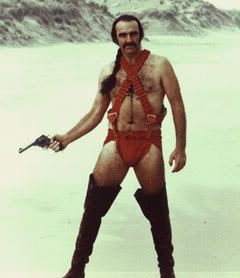
When reading that Cronon essay for the 10th time the other night I was struck by the passage about the model frontiersman being hypermasculine. The image I had fought so hard to bury - a young Sean Connery wearing little more than thigh-high boots and a weird red leotard - came to me. Yes, my friends, I have come here to discuss one of the greatest films ever made - John Boorman's Zardoz.

While Zardoz is far from the perfect allegory for "Getting Back to the Wrong Nature", it is chock full of colorful illustrations of problems that arise from the wilderness concept Cronon urges us to drop. Actually, the film is so outlandish that you could probably put any kind of spin on it (paper topic alert), but on to my point. Two distinct classes exist in the post-apocalyptic setting of Zardoz - a small group of feminine, super intelligent and immortal beings with telepathic powers (Eternals), and the barbaric race of men who populate the Earth.

The Eternals are an exaggerated picture of the upper echelons of our society. On the one hand they entertain one another with telepathic banter and hold quaint meetings to work through the issues in their community. On the other hand they seem to be completely detached when it comes to exploiting the Sean Connery's of Earth to get their food (the Eternals are vegetarians). They even go so far as to recruit a subset of 'brutes' whose sole purpose is to keep their own population size in check.

Though they live in luxury and have cool powers, the Eternals can't help but be sad about having to live forever. Fortunately, things get shaken up when Sean Connery finds a way to enter their world. The Eternals discover that this brute is far more complex than they originally presumed.

I have probably already said too much. This is a must see movie and I don't want to ruin it for you. I'm getting together with another ntres232 person to watch it this Friday or Saturday and you are welcome to join us.

A trailer:

"Man" - Nature themes in Planet of the Apes

Hi everyone,
we mentioned Planet of the Apes in class this week, and there is a lot of potential there for an interesting term project for the course.

I alluded to the famous final scene of the movie (1968), where Charlton Heston discovers the Statue of Liberty and realizes he's been home all along. Great, great stuff.


This clip is of that final scene. Enjoy.

Tuesday, February 19, 2008

Cronon-bashing

Hey guys,

Check out this critique of Cronon's "The Trouble with Wilderness," written by "Guy Tal" on the Essential Landscape Web Journal:

http://scenicwild.com/serendipity/index.php?/archives/29-Why-William-Cronon-Doesnt-Understand-Wilderness.html

Anyone able to give a critique of his critique???


" Why William Cronon doesn't understand wilderness:

Someone recently sent me a link to a belabored diatribe titled "The Trouble with Wilderness; or, Getting Back to the Wrong Nature" by Professor William Cronon of the University of Wisconsin. It was an enlightening read.Other than starting the article by failing to note or articulate the difference between Wilderness and Wildness (and thus completely missing the essence of the famous quote from Henry David Thoreau), Cronon's idea of Wilderness somehow manages to be out of touch with every single formal definition of the term, whether legal or common. His bombastic title and lengthy analysis all seem to revolve around the unfounded perception that wilderness advocates promote a notion that "the human is entirely outside the natural." This premise is patently false. No definition of the term excludes human presence or experience from the natural world. If anything, wilderness is defined by its relation to humans, and by excluding certain human constructs and activities, but never humans presence. The Wilderness Act of 1964 defines wilderness as an area "untrammeled by man", rather than an area where man has no presence or stake or experience.

To claim that wilderness excludes all human experience is like claiming that virginity excludes any romantic interlude between lovers, rather than very specific physical acts. It's like claiming that criminal laws excludes all freedoms, rather than specific deeds deemed to be harmful to society. It is, in essence, a gross mischaracterization, and false representation of what the term means to most of those who espouse it.

For such a contentious title, one would think a conclusion will be pretty self-evident, and yet you would have to look pretty hard to find out exactly what Cronon thinks "the trouble" actually is: "a flight from history" (really?), "an escape from responsibility" (huh?). In a way it seems he is trying to construct a fictitious point only to triumphantly tear it down and claim it is false. Wilderness activists are not trying to escape from responsibility - if anything they are trying to assert responsibility. They are pointing out all the spiritual and ecological values of restraining industrialization and sprawl so that the historic account of human-induced devastation serves as a lesson rather than something to ignore or escape. How easy it is to twist words and meanings to "prove" a point.

While searching through the article for "the trouble with wilderness" you may actually discover some trouble with religious beliefs, politics, racism, and a number of other far more blatantly flawed human perceptions than the modern idea of wilderness.

Would one not expect an educated analysis to begin with a clear and commonly-accepted definition and understanding of a concept before attempting to show "trouble" with it?

The Wilderness Society, founded by Aldo Leopold defines its mission in a single line:

"Deliver to future generations an unspoiled legacy of wild places, with all the precious values they hold: Biological diversity; clean air and water; towering forests, rushing rivers, and sage-sweet, silent deserts."

Read it again: deliver to future generations... they do mean generations of humans! Where exactly does Cronon get such warped perceptions as "a crude conflict between the “human” and the “nonhuman”"?

In my mind it was Edward Abbey that framed the real trouble with wilderness:

"The idea of wilderness needs no defense. It only needs more defenders." "


LM Note:

“Untrammeled. A key descriptor of wilderness in the Wilderness Act, untrammeled refers to the freedom of a landscape from the human attempt to intervene, alter, control, or manipulate natural conditions or processes to provide particular benefits.” — FWS Draft Wilderness Stewardship Policy, 2001

Deer population control at Cornell

February 19th's issue of the Cornell Daily Sun had an article about the methods in which Cornell will attempt to curb its deer population. I have no problem with taking measures to control deer populations for ecological reasons, since humans have eliminated their natural predators and overpopulated deer can overgraze and alter the natural habitat. However, I do have a problem with the motives this article listed for Cornell's deer control program: deer-vehicle accidents and damage to crops, ornaments, the Arboretum and Botantical Gadens, and research plots. I believe that limiting deer-vehicle accidents is a more serious factor than the other motives listed in the article, but it is still mostly a superficial motive for curbing the deer population because deer are usually to small to harm a person in a collision, they usually just damage the car. The article also said that that Cornell fences was considering putting errecting 8 foot tall fences arround the core of the campus. These fences would be much more of an eyesore than the eyesore of whatever landscaping or "ornamental damage" the deer might cause. Furthermore, I would gladly sacrifice seeing some obscure plant in the Botanical Gardens, that the deer would eat, to spot a deer there instead. As I said before, I am not opposed to controlling Cornell's deer population, but I am opposed to the superficial motives for controlling the population listed in this article.

The article is titled Program Aims to Limit Number of Deer and is written by Alix Dorfman.

The Trouble with Enivronmentalists

The other day I was having a conversation with an Economics major who was becoming interested in environmental careers. I encouraged him, noting all the important things someone with a background in economics could do to help people and the environment. He was happy to hear this and explained that he used to think of environmentalists simply as people with protest signs who chained themselves to trees and tried to preserve remote ideals. (My mind immediately went to the spotted-owl controversy.)
I have encountered this view of environmentalism on more than one occasion and I think that William Cronin, in 'The Trouble with Wilderness' really helps to explain why this is not the proper way to approach environmentalism. Personally, I believe human suffering should be addressed before anything. But it is in maintaining a healthy planet that we can best alleviate and prevent suffering. As Cronin points out - we are part of nature. Agriculture, pollution, and disease are all environmental issues that directly affect humans. However in my view, conservation is equally important. And while the latter issues tend to be politically popular to address, conservation seems to be met with more resistance. I argue that conservation is just as much a human-related issue as pollution, disease, etc. As Cronin notes, life will go on, with or without us. Conservation is about protecting the planet in a state where humans can flourish - a state most likely similar to that in which humans evolved, which includes lots of 'natural' land to recycle our wastes and provide us with food and clean air. Thus environmentalists, including conservationists, are not simply tree hugging protesters (not to say I don't hug trees from time to time); to me, environmentalists are people who are concerned about people and importantly, humanity's future

Monday, February 18, 2008

The Course of Empire

The Course of Empire--Destruction

Hi everyone,
The entry for Cole's The Course of Empire at Wikipedia is surprisingly decent--plus the five paintings of the series are each reproduced digitally with good resolution jpegs. Enjoy.
jt

Sunday, February 17, 2008

Hunting rituals

As I read The Ecological Indian: Myth and History - more specifically the chapter on Buffalo - I cannot help but notice similarities between certain hunting rituals performed by Plains Indians, and by English royalty or nobles back in medieval times. For example, Krech mentions that Euro-Americans were disgusted to witness Indians " 'devouring the meat still warm with life' " and disturbed by the " ' savage scene' " of Indians smearing buffalo blood all over their faces. The Euro-Americans feelings of disgust (and maybe of superiority over these "savages") are sort of amusing to me, especially when remembering things we've read about English hunting rituals: the presentation of fresh deer droppings to the queen, the opening of the fresh deer carcass to cut out and distribute certain organs to certain people, the dipping of bread into the carcass to soak it with blood before eating it, and even how royal ladies would cover their hands and faces with deer blood, because they thought it was great for their complexion.

Friday, February 15, 2008

Spirited Away: River God

Near the end of class, Hayao Miyazaki's film "Princess Mononoke" was discussed for some time. I also wanted to bring attention to another Miyazaki film that incorporates the idea of humans having a negative impact on the environment. This film is "Spirited Away", and just to give people some background, the main character is a girl named Chihiro who enters a spirit world. She ends up working in a bath place, where she encounters the suffering river god:

http://youtube.com/watch?v=14FXLHMTNF4

This is how Wikipedia explains the river spirit:
River Spirit (川の神 kawa no kami)
A customer of the bathhouse originally thought to be a "stink spirit" who is assigned to Chihiro and Lin. Yubaba suspects that he may be something more than a stink spirit; when Chihiro helps him by pulling trash that had been dumped into his river out of his side (Miyazaki had a strong interest in the environments and wished to portray the destruction of rivers), her suspicions are proven correct. He is in fact a famous and wealthy river god. As a reward for cleaning him, he gives Chihiro a ball of plant material which, viewers are told by Kamajii in the English-subtitled version, is a "healing cake". In the English dubbed version, Kamajii simply states that it is medicine from the river god. The "healing cake" is later used to heal an injured Haku through ingestion and to cause No Face to vomit the people and vast amounts of food he ate during his rampage. It is implied that the taste of it is extremely bitter, as demonstrated when Chihiro tries a bite and reacts violently.

Thursday, February 14, 2008

A Refreshing Walk

I was curious to see what other people thought of the Thoreau article this week - "Walking". I had mixed reactions to it. On the one hand, Thoreau clearly goes overboard at some points and says things that he probable doesn't actually mean. For example, on page 196 he says "A successful life knows no law," a little extreme if you ask me. But overall I really liked the article. Extreme or not, it helps to remind the reader of things he or she may forget from time to time. Nature truly can be a place to clear the mind and embrace a more uninhibited side of ourselves. He reminds us of the importance of leaving the working world behind from time to time and simply venturing into the great outdoors, however much of a struggle it may be to forget our worries. Interestingly, he even calls nature a "sacred place" on page 182, which is reminiscent of the Greek and Roman approach to wilderness. He also connects nature to freedom and purity and talks extensively about his yearning to go westward, to follow the future. Unfortunately I think this perspective can be and was used to encourage the fulfillment Manifest Destiny and inspired in some people a desire to conquer nature rather than live peacefully with it. In spite of the possibility of misinterpretation, I think the article on the whole is a worthwhile reminder that an occasional foray into nature can offer the mind repose and clarity and can rejuvenate a person's sense of 'wildness'.

Wednesday, February 13, 2008

The history of Smokey Bear


While perusing the internet, I came across the banner advertisement on the left. I felt the ad was prophetic enough, so I journeyed over to www.smokeybear.com and looked through the history of this iconic legend. As it turns out, the original 'fire prevention campaign' was waged with the assistance of Disney's Bambi. The campaign was allowed to use the image of a fawn for a year; however they had learned how effective an animal mascot could be for getting information to the public. Later that year, Smokey Bear was created, and from that day in 1944 until now,

'Only you can prevent wildfires.'

Here's the informational link:

http://www.smokeybear.com/vault/bambi_bear.asp

Bambi in the News......

http://www.boston.com/news/nation/articles/2006/05/20/ill_university_launches_safety_campaign_after_several_deer_attacks/

In the article on "The Trouble With Bambi", by Ralph H. Lutts, that we have to read for Friday Lutt mentions a references to Bambi in the conflict about the deer population in Massachusetts and New England. This reference makes a lot of sense if you are from the Boston/New England area and have this issue constantly discussed in your local news. The above article has a reference to Bambi from the Boston globe that claims to be showing the "true nature" of the of Bambi, or deer. I mostly found this interesting because the image of Bambi as the cute, tame, creature has led people to believe they are nothing more that stuffed animals for us to pet, and then are shocked when they are injured. Our society's conception of animals is molded by cartoons, books, and zoos and the true nature of wild animals seems to have been lost. This only becomes a problem when there is an incident such as the tiger attack this winter in San Francisco. How do you successfully teach children to love and protect animals and still instill an amount of respect of their wild nature to protect both the animals and people? As "The Bambi Syndrome" points out our concept, as a society, of deer is often primarily shaped by the movie Bambi, but how much has it shaped out concept of all animals outside the hunting sphere, and our interaction with them?

Tuesday, February 12, 2008

Disney Films


I find it funny how there are certain trends that Disney uses in his films. Have you noticed how the mother is always killed? Snow White, Bambi, Lion King, and of the old children's stories that we grew up with. I am sure that Freud would have had a field day watching these films!!

What I really wanted to bring up was the movie Ferngully. This was a powerful film that addressed current issues at that time. For those who did not have the pleasure of watching this film, the plot is as follows: we meet the evil, polluting and destructive monster logging machine on its way to the beautiful and vibrant rain forest-- where we meet kind and sexy ( yes, strange that that is an element but the main character fairy is scantly clad) fairies who win our hearts. So the lumberjack ( also a sex symbol) walks through the forest marking trees to be destroyed ( all of them--an interesting comment on the idea of sustainable logging practices) and he is somehow transformed into a fairy sized man and learns about all of the destruction he is causing. Funny that he does not bring the fairy into his home and show her how he has a family to feed (a common argument for loggers, is it not?)

Bambi was made in a time in US history that people were very interested in preserving natural areas. Presidents were setting aside national monuments out west (think Teddy Roosevelt) and there was the argument between absolute preservation and mixed use. I would argue that Bambi reflects the absolute preservationist view that humans or "Man" is BAD and can only cause harm.

These two movies have probably shaped many of our views toward nature and conservation as well as other views (insert Freud comment here)

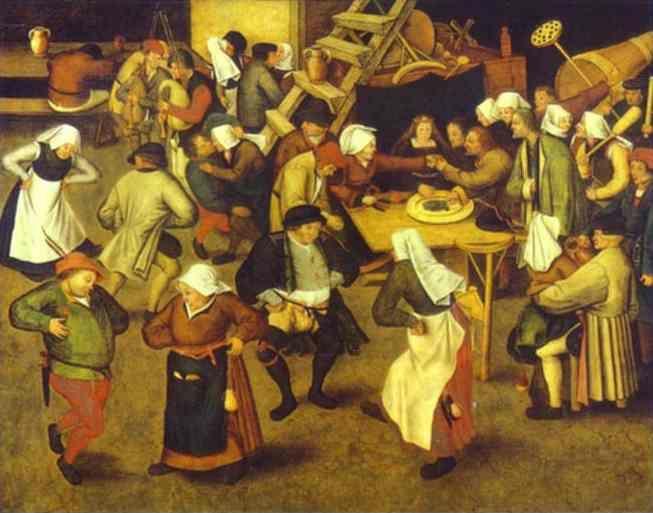
Pieter Brueghel Elder and Younger

www.abcgallery.com/B/bruegel/pieter5.html


Someone mentioned in class today another painting called "The Peasant Wedding" which was of the outside of the wedding. This painting was painted by Pieter Brueghel the Younger (the oldest son of Pieter Brueghel the Elder) after his father died. Are there any clues or things in the painting that hint that it is the same wedding that was portrayed by Brueghel the Elder?

History and Wilderness

While reading the Cronon essay on Wilderness, and couple of points really jumped out at me in connection to the Lowenthal reading we had earlier in the week. Lowenthal highlighted the tendency of Americans to disengage the past with the sense of hope that lay in the present or for some, the future. He also mentioned the more recent tendency of American’s to dwell on nostalgic ideals of our nation’s history, in stark contrast to the “antihistorical bias” that “made Americans feel that their country's unique destiny demanded disengagement from the heritage of human history” (91) that characterized the earlier years of the nations life. Although there cannot be an exact date to mark the changing ideals, he did give light to the general time period. In Cronon’s essay, when discussing another evolving ideal-the concept of wilderness-he makes an interesting point in connection to the importance of historical preservation…

“Thus, the myth of the vanishing frontier lay in the seeds of wilderness preservation in the United States, for if wild land had been so crucial in the making of the nation, then surely one must save its last remnants as monuments to the American past-and as an insurance policy to protects its future. It is no accident that the movement to set aside national parks and wilderness areas began to gain real momentum at precisely the same time that laments about the passing frontier reached their peak. To protect wilderness was in a very real sense to protect the nation’s most sacred myth of origin” (76-77).

I just thought it was a really good example of how different aspects of a nation’s history can bring about completely different perspectives of how significant that history actually is. When reading Lowenthal my idea of history was mainly wars and rulers, but this passage gave me a couple new ideas.

Monday, February 11, 2008

The Translation of Livre de Chasse

Hey Everyone,

I e-mailed Jacqueline Stuhmiller tonight as she was a previous teacher of mine for one of my freshman writing seminars. I asked her about her translation of Livre de Chasse for her dissertation and she immediately responded to me. She said that it is indeed finished but not published as it is still in rough form. However, she asked me if there was any thing I wanted to know and/or needed help with, so if anyone is more interested in this please let me know and I can get in touch with her for you (my net id is ahz2).

More on Dutch landscape art

There is a large number of resources available online to study the art we will be looking at over the next few weeks. For example, The National Gallery of Art has a nice selection of Dutch landscape and seascape paintings available for viewing online, with accompanying narrative commentary.

Here is an excerpt that places Dutch art in context:
The emergence of the Dutch school of painting in the early seventeenth century is one of the most remarkable phenomena in the history of the visual arts. The Dutch Republic, a small country that had only become a political entity in 1579 and was still suffering from the effects of a long and arduous war with Spain, would hardly seem to have had the resources to nourish and sustain its artistic traditions. Nonetheless, in every respect, the Dutch seem to have drawn strength from adversity; they profited in terms of trade, political awareness, religious tolerance, wealth, and above all, self-esteem. They were proud of their achievements and were determined to provide for themselves a broad and lasting foundation that would define their unique social and cultural heritage.

The political and religious attitudes of the period are not readily apparent in the work of Dutch artists. The still lifes, portraits, landscapes, seascapes, and genre scenes that characterize this school of painting are surprisingly lacking in information on the major events of the day. Nevertheless, the philosophical bases from which artists worked are clearly the same as those governing decisions in contemporary political, military, and religious activities. This ideology was essentially threefold: that God's work is evident in the world itself; that, although things in this world are mortal and transitory, no facet of God's creation is too insubstantial to be noticed, valued, or represented; and that the Dutch, like the ancient Israelites, were a chosen people, favored and blessed by God's protection.

Underlying the essential realism of Dutch art, thus, is an allegorical view of nature that provided a means for conveying various messages to contemporary viewers. The Dutch, with their ingrained Calvinist beliefs, were a moralizing people. While they thoroughly enjoyed the sensual pleasures of life, they were aware of the consequences of wrong behavior. Paintings, even those representing everyday objects and events, often provide reminders about the brevity of life and the need for moderation and temperance in one's conduct. Subjects drawn from the Bible, mythology, and ancient history, likewise, were often chosen for their moralizing messages or for establishing parallels between the Dutch experience and great historical, literary, and political events of the past.

For further resources, check out some of the links on the "old" course web page.

Forest Scene, c. 1655
Jacob van Ruisdael

Sunday, February 10, 2008

Is Nature Still "The Beast"?

As I sat watching the television the other evening, I noticed a trend among several advertisements for kids shows. In all of them, the "bad guy" was represented by someone who had embraced technology, i.e. had metallic/robotic armor or utilized robots to do his dirty work. The good guys? Well most of them seemed to be living very simple, "closer-to-nature" lives. What does this say about modern society's perception of nature? Is nature still viewed as a "beast" that needs to be conquered and tamed? If the kids shows can be taken to reveal societal perceptions, then perhaps not. I think that's kind of interesting...

Friday, February 8, 2008

The invention of capitalism and the game laws

My thanks to Meredith for those links below. More on Blackstone on Monday.

Here is link to a book review of the book by Michael Perelman I cited in lecture about the "invention of capitalism." More on Perelman perhaps on Monday as well, but here is an excerpt from that review that illustrates further the significance of the game laws as discussed in class.

The enforcement of the game laws, feudal in origin, peaked during the industrial revolution, separating ruralists from their source of sustenance and pressuring them to accept wage labor. Ultimately, writes Perelman, the game laws actually resulted in undermining the feudal aristocracy's hegemony in British society. But at first incredibly harsh applications prevailed; indeed, even foraging for berries was made a crime in Germany. Hunting was crucial for supplementing sustenance for the families of the rural poor. From early in the nineteenth century, poachers were severely punished, "some actually executed." Some 30 to 40 percent of all male criminal convictions were for infraction of the game laws, and a "substantial number of poachers who resisted arrest were transported to Australia." The feudal game laws became much harder under early emerging capitalism because "the interests of capital and the gentry coincided."

"The gentry could enjoy the pleasures and prestige of hunting, while the capitalists could enjoy the labor of the many people who were forced to hunt as a means of subsistence," Perelman writes. He quotes William Cobbett, who noted in 1823 how a young countryman, questioned how he lived on a half-crown per week, replied, "I don't live upon it--I poach; it is better to be hanged than to be starved to death."

What's more, a further factor in the game laws' pressuring the peasant labor into factory work was allowing the ravaging of the farmers' crops by protected (for the gentry) game like deer, hares, and birds. "In the 1840s an estimated quarter of the crops of Buckinghamshire were destroyed by game," writes Perelman. Yet Parliament did not grant farmers the right to kill hares on their land without permission of their landlords until 1880. And in the first decades of the nineteenth century, 1,300 persons were imprisoned under the game laws in Weltshire alone. Compounding the destruction by game, the gentry's foxhunting allowed riders to traverse scores of miles, beating down unharvested grain and corn, trampling turnips, injuring pregnant sheep, breaking fences. The gentry hunters claimed right of access to every man's land.

Perelman's book is really quite interesting--great topic for further reading!

Have a great weekend everyone.

La Belle et la bête

http://www.imdb.com/title/tt0038348/


They have the movie in Olin Library media center

http://catalog.library.cornell.edu/cgi-bin/Pwebrecon.cgi?Search_Arg=belle+et+la+bete&SL=Submit%26TYPE%3Dgm%7C9&Search_Code=TALL&PID=0qSI9DwzRKctmX-gKr_giWrUVCY&SEQ=20080208113352&CNT=50&HIST=1

Does anybody want to get together and watch it?

Mr. William Blackstone- The law maker

http://en.wikipedia.org/wiki/William_Blackstone

Here is a link about Blackstone. I was just curious to find out more about him, and what role he played in the laws of England and influence he had on they topics we are covering in class.

Thursday, February 7, 2008

To follow up on our discussion of Sir Gawain and the Green Knight, below is a posting for an upcoming 4-week short class on Parzival and the Quest for the Grail. If you're interested in Arthurian legend, read on.

PARZIVAL

and the Quest for the Grail

A class taught by Jay Leeming

Parzival is the story of how a simple boy succeeds in healing his entire kingdom by finding the mysterious castle of the Grail, a castle that “cannot be found by those who seek it.” It is one of the central myths of our culture, a myth which we continue to live through in both our foreign policy and our daily lives. Celtic in origin, it begins with a single mother’s attempts to keep her son safe from a violent world in which the forces of Islam and Christianity are in deadly conflict. The resolution of the story requires the healing of this conflict, and the opening of Parzival’s heart to the sufferings of others and of the natural world. It is a story in which the earth herself comes to King Arthur’s court as a mule-riding Goddess with boar’s teeth and braided eyebrows; in which not simply heroic deeds but also failure and grief are ways to move forward; in which the Grail is guarded by a wounded King fishing from a jeweled boat.

A story such as Parzival is like a wild animal that, if we are willing to nourish it, will enter our lives and infuse them with a greater sense of depth and meaning. It is a map drawn by the generations that have preceded us, containing knowledge with which we may heal both ourselves and our communities. It is a landscape often best entered with others, where we may find underground rivers and bramble-covered walls of stone, where we may discover jugs of wine, turquoise necklaces and a snow-filled forest reflected in a falcon’s eye.

This workshop will focus on experiencing the myth of Parzival in the old way, as a story spoken aloud. Jay Leeming will tell the story in four parts, and along the way participants will be invited to engage with the story through a variety of creative means including discussion and writing. We will also read selections from Wolfram Von Eschenbach’s 13th-century version of the myth, exploring the mix of Celtic, Christian and Sufi cultures out of which this ancient poem has been cooked. We will move through the story together, using our varying perspectives to deepen our relation to it and to our own lives.

Sundays, 2:30-4:00, February 24th to March 16th

Downtown Ithaca Cost: $50

To register, call (607) 273-6325 or send an e-mail to: JayLeeming@yahoo.com

Jay Leeming is the author of the book of poems Dynamite on a China Plate and a long-time student of mythology. His poems have appeared in the Gettysburg Review, Ploughshares, Rattapallax and Poetry East, and been featured on Garrison Keillor’s Writer’s Almanac on NPR. He has taught and read poetry at Butler University, the Woodstock Poetry Festival, Robert Bly’s Great Mother Conference and the International Centre for World Spiritualities in Edinburgh, Scotland.

“Here begin the terrors, here begin the miracles”

Wednesday, February 6, 2008

BBC timeline of British history


For anyone interested in the historical context for the readings on the Game Laws, the BBC has a great interactive timeline of British history:

http://www.bbc.co.uk/history/british/launch_tl_british.shtml

Sunday, February 3, 2008

The Game Laws: more "contested terrain"

(Image from http://www.robinhoodloxley.net/mycustompage0016.htm )

In Ch. 3 on the Game Laws, Manning states: "The Game Laws... rested upon two rather dubious assumptions: that hunting, the most universal of all sports, one of the most common varieties of social intercourse, and one of the most persistent expressions of culture in every society with its rites of passage and highly emotive bonds of fraternity, could be and ought to be restricted to a privileged few. The second assumption was that deer and hare, which the common law regarded as ferae naturae – things of pleasure rather than profit and upon which no value could be placed in an indictment at common law – could be stolen. This legal absurdity was so apparent to lawyers that, when they drafted statutes in Parliament or framed indictments and informations in courts of law, they understood that only the circumstances in which a deer or hare was taken could be made a crime – not the act itself." (Manning (1993), Hunters and Poachers: A Social and Cultural History of Unlawful Hunting in England, page 59)

Perhaps it's no surprise that enforcement of the Game Laws was sporadic, and that Robin Hood became a popular hero.

In previous posts, we've seen nature preserves as wildlife sanctuaries (Quimby's property in Maine) and as sacred groves (Ch. 10 in Pan's Travail). From this week's readings on the Game Laws, royal forests and deer parks were another way to cordon off "nature" under certain circumstances. How do these different approaches to nature preserves relate to the different meanings of "nature" we've discussed? What different values, meanings, or states of "nature" might have been relevant to the supporters of Game Law or forest law? To those opposed?

Friday, February 1, 2008

The english accent is so charming


"Robin's myth, like the Green Man's activates a set of oppositions between nature and industry or commerce, fertility and decay, countryside (or forest) and town, and freedom and constraint. William Anderson, in The Green Man, discusses the links between the two myths, pointing out they are both linked to May Day festivities and that Robin Hood's 'connection with the Green Man is strong not so simply because of the green he and his merry men wore but because so man inns called 'The Green Man' portrayed him on their signs' (Anderson 1990, p 29).... the cinematic resurgence of Robin Hood in the 1990s is perhaps not surprising in view of increasing concern on both sides of the Atlantic about urban sprawl and environmental pollution. However, there is nothing new about the nostalgic desire to return to a pre-industrial period. This romantic view of the past as a Golden Age when man lived in harmony with nature, is itself a myth and one that has been drawn upon by writers in different periods over the past four centuries. In 'As You Like It', for example, Shakespeare used Robin Hood to symbolise this idealised view of the past."

From: "Reconstructing Robin Hood: Ideology, Popular Film, and Television" by Dudley Jones, found in the anthology A Necessary Fantasy? The Heroic Figure in Children's Popular Literature by Jack Zipes (available on Google Book Search)

Here's a question: What's up with Disney using anthropomorphized animals to illustrate the main characters? Isn't Robin Hood a story about poaching? (you'll get to it with next week's readings). Keep in mind the cultural climate of 1973. The Disney version just smacks of early 70s, chocked full of folk music and partial nudity! No really, if you haven't seen it, it may be the best Disney movie ever. As Professor Tantillo would say, "Great term paper topic!"

If you just can't get enough Joe Knowles . . .


Hi everybody,
Just in case you haven't gotten enough Joseph Knowles this week, here are two items.

First, a glorious Joe Knowles beefcake shot (above) from Knowles's book, Alone in the Wilderness. Suitable for framing!

And second, a book about Joe Knowles has just been published--as in published four days ago! You are among the first to hear about this publishing landmark. Naked in the Woods: Joseph Knowles and the Legacy of Frontier Fakery, by Jim Motavilli, tells the story of our hero and places him in broader cultural context. Here's the blurb from amazon.com:
One hundred years ago, Joseph Knowles staged America's first Survivor-like "reality shows"--questionable adventures in the wild, fueled by tabloid wars and wilderness hysteria. Joseph Knowles was a forty-five-year-old part-time painter, ex-Navy man, friend of the Sioux, and onetime hunting guide who stepped--nearly naked--into the woods to live off the land and his own devices. From 1913 to 1916, Knowles's dispatches to the world--alternating accounts of bear clubbing and quiet contemplation, written in charcoal on pieces of birch bark--set off major newspaper wars, exploiting readers' fears of modernization. Did Knowles really survive for months at a time in the untamed wilderness without any aid, and why is the answer still so vital to the American psyche? Part adventure story, part cultural investigation, Naked in the Woods reveals a whole new dimension of our natural history.
Be the first kid on your block to read this book.

Anyway, have a great weekend everyone.

Wednesday, January 30, 2008

I am cow


Today in lecture when discussing chronological primitivism, Professor Tantillo mentioned that the transition from vegetarianism to meat-eating could be described as a sin or fall of humans. In response to this, (and after hearing the Ape Man song), I am posting a link to a song that kind of highlights this point. It's called "I am cow" by the Arrogant Worms.

http://www.youtube.com/watch?v=JcPz850o3d4

I think this song (aside from having pretty good harmonies) highlights some of the important environmental consequences of eating meat. For example, the second verse talks about cows' contribution of methane gas to the atmosphere and its effect on the ozone layer. A 1988 article writes, "Humans are responsible for increased methane levels because they are raising more cows, growing more rice and chopping down tropical forests, which provides food for more termites".
http://query.nytimes.com/gst/fullpage.html?res=940DEEDF143CF93BA35750C0A96E948260&scp=1&sq=methane+and+ozone&st=nyt

A more recent report shows that methane gas accounted for 14.3% of the anthropogenic greenhouse gas emissions in 2004 while CO2 fossil fuel use consisted of 56.6%.
IPCC Report: http://www.ipcc.ch/pdf/assessment-report/ar4/syr/ar4_syr_spm.pdf

The third verse also hints at the fact that there are a lot of cows living on the land. From an environmental perspective, this would mean that land needs to be cleared for the cows to have pastures to graze on, etc.

I hope the song and NYT article give a perspective to the concept of "chronological primitivism" being " the primitivism that looks backward to a “Golden Age” and sees our present sad state as the product of what culture and society have done to them". (definition taken from
http://www2.english.uiuc.edu/finnegan/English%20251/primitivism.htm

Check out the Joe Knowles picture gallery


As mentioned in lecture, on the old course web page. Enjoy.

Monday, January 28, 2008

Gilgamesh

I was interested in the Epic of Gilgamesh and wanted to learn more, I found this website if anyone else is interested.

http://www.wsu.edu/~dee/MESO/GILG.HTM

Also I was wondering what other people thought about the encounter between Enkidu and Gilgamesh and their teamwork in destroying a cedar forest and travels between wilderness and the city of Uruk?

Saturday, January 26, 2008

Sacred precincts- strictly Greek?

Sacred grove of Zeus, Olympia Greece


On pg. 172 of "Pan's Travail", Hughes states,
"The rules protecting land reserved for the gods [in ancient Greece] were strict and numerous, and followed a consistent pattern although specific laws varied from place to place and in different periods. The underlying principle was that the groves were property of the gods and ought not be damaged in any way. First was a definition of the boundary of the sacred area and a prohibition against trespass. To step over the line, however it was marked, was to pass from ordinary ground to holy ground, and was allowed only for those who were prepared and would not pollute it."


Read the post below. How does the idea of a sacred precinct relate to Roxanne Quimby's nature ethic? Is the idea of a "wildlife sanctuary" unimpeded by human impact a new concept, or unique to America? Why is it that 'nature' remains a "contested moral terrain"?

Friday, January 25, 2008

Roxanne Quimby and Maine land protection


Here is an article about Roxanne Quimby, who purchased the 24,000-acre Township 5 Range 8WELS in Maine several years ago.

The article describes Quimby's land management philosophy:
Quimby’s intent for her latest property will be "wildlife sanctuary" -- a designation that will mirror the management of the adjoining Baxter township, T5R9. "I'm interested in creating wilderness to allow natural processes to evolve" and where human impacts are as minimal as possible, she said. In keeping with her policy for her other conservation lands, there will be no timber harvesting and no hunting in T5R8. Motorized access will be limited, Quimby said.

The article further goes on to state, "The environmental organization RESTORE: The North Woods is working to establish a 3.2 million-acre national park and preserve around 'forever wild' Baxter State Park. Quimby has been a public advocate of RESTORE’s effort."

Great term paper topic!!

Wednesday, January 23, 2008

Voluntary Human Extinction


Hi everyone,
today in class we mentioned the Voluntary Human Extinction Movement, or VHEMT.

The VEHMT web site summarizes the movement's philosophy: "Phasing out the human race by voluntarily ceasing to breed will allow Earth's biosphere to return to good health. Crowded conditions and resource shortages will improve as we become less dense."

You can check out more of their philosophy on their web site at http://www.vhemt.org/ . Enjoy.

Monday, January 21, 2008

Welcome to Spring 2008!


Hi everyone,
welcome to the class blog for NTRES 232, "Nature and Culture"! Enjoy.

Friday, May 18, 2007

The Semester is Over...

Ok... This is a blog from ANNA DEGOLIER... Since I have never signed up for the blog and my blog invite has expired I have to use my friend's username to post it. Here it goes...

And so the semester is over and along with it the 3 credit course that should have definitely been a 4 credit one. One thing that I would recommend to anyone taking this course in the future is to make sure they don’t take more than two humanities if they are taking Nature and Culture 268. The class is certainly worth it. Besides discovering something new for yourself you get to be entertained by professor Tantillo’s jokes three times a week. I’ve learnt some of the most astonishing facts such as that Greeks and Romans weren’t really such glorious civilizations as most of the history books try to portray them; indigenous population of America has committed a number of crimes against nature including the famous “buffalo jump”; the development of industrialized cities like Chicago have scarred the face of the earth for many years to come by skinning the land off its vast forests, driving wild buffalos to almost complete extinction and polluting the atmosphere with dirt coming out of industrial chimneys. I’ve learnt that the so-called wilderness has been manipulated by humanity for thousands of years and that people usually don’t realize this to say nothing about giving credit to those people who have maintained the beauty of this wilderness by enforcing its thoughtful management. And can you believe that Niagara Falls can actually be shut down?! …and not just for a second but for a whole summer?!
But most importantly, no nation, or culture, or civilization has distinguished itself for living in perfect harmony with nature. All of us have made a nice share of mistakes and have contributed to the environmental degradation that has been accumulating over the many centuries of man’s interaction with nature. Our main mission though is not trying to figure out who has done the most damage and should be persecuted, but how to improve the practices that are still being used today and minimize their harmful effects on nature while keeping the consumer happy, and how to maintain respect for ourselves not only in our children’s and our own eyes, but in the eyes of hundreds of generations that are still hopefully to come.

Friday, May 11, 2007

Feel like an activist?


Hi guys-- Just thought that it was ironic that this email popped up in my inbox last week. Do with it what you will... :)

Hi Leigh,

With over 177,222 harp seals and seal babies slaughtered to date, it seems like things couldn't get much worse in Canada. Yet, brutality witnessed on the ice this month by the seal hunt observation team was simply shocking. They need your help more than ever.

Sign the petition to boycott Canadian seafood until Canada stops the hunt: >> http://go.care2.com/e/R8Yd/Hi4Y/eOPo

The seal observation team helplessly documented sealers flouting Marine Mammal Regulations. Without checking to ensure the babies were dead after an initial blow, sealers have stabbed the still-struggling seal pups with boat hooks and dragged them onto the boats to be flayed. [1]

And perhaps equally horrifying, instead of trying to enforce the law, fisheries officials asked the observation team to move further away from the slaughter. Apparently, the presence of the team was “upsetting” the hunters.

Don’t do business with baby seal hunters – sign the Canadian seafood boycott petition >>

Why is a boycott powerful and effective? Seal hunting is an off-season activity for Canada's east coast commercial fishermen. Only a small fraction of their income comes from selling seal skins to the fur industry. The majority of seal hunters’ annual income is made through seafood products such as snow crab, cod, scallops and shrimp. Do your part by boycotting today: http://go.care2.com/e/R8Yd/Hi4Y/eOPo

What's more, global warming has made it hard enough for seal pups – even without this brutal hunt. Thin, broken ice and higher than usual mortality rates have already had a profound effect on seal pups in the Gulf of St. Lawrence this year. Ninety percent or more of the seals born in the southern Gulf this year have died, and sealers targeted the few surviving pups.

There is no way to defend this type of annihilation. But there is hope. Seafood is the main source of income for most seal hunters. If enough people pledge to boycott Canadian seafood, we can force hunters to give up this brutal hunt.

Thank you for doing your part to stop the Canada seal hunt!

From Care2.com
Robyn E.

Care2 and
ThePetitionSite Team

Thursday, May 3, 2007

"Environmentalism vs. Skepticism"

I read this debate in today's USA Today and thought it was very relevant to the readings and topics we've been discussing in lecture lately:

Environmentalism vs. Skepticism

It talks about how science is necessarily biased because it reflects the interests of the researchers; it should not be accepted as "pure as a mountain stream." In the same way that Shrader-Frechette questions the validity of using "underdetermined" science in decision-making, Cal Thomas claims that we cannot use scientific predictions about global warming to justify major preventative measures against climate change because these scientific speculations are uncertain. Also, the discussion is reminiscent of Dunlap in that Thomas likens environmentalism to a religion: "For the secularists, planet-worship has replaced holidays like Christmas and Easter." It's interesting (and satisfying) to see a real life example of how the ideas we've been discussing are very pertinent to current discussions of environmental issues.

~Katie Hansen

Wednesday, May 2, 2007

Ontology and the Existence of Matter

In the article by Barry Smith and David Mark, Do Mountains Exist? Towards Ontology of Landforms, a philosophical argument is posed concerning the very existence of geographic features as well as other facets of nature that humans regularly interpret. The method of philosophy that underlays the argument of this essay is called ontology, or as the Princeton University web dictionary defines it: "the metaphysical study of the nature of being and existence." Essentially, the essay makes a few key points that I caught on to while reading, they include:

1. Philosophical ideas and particularly ontological ones, have and will continue to change as scientific thought progresses.
2. Ontology is made up of a primary and field based interpretations, by both average people and scientists; creating a basic level of interpretation of the environment all the way through a very advanced one.
3. People use different methods of interpretation to validate what they see in nature. From children's stories to advanced mathematics, many methods are used by humans to compartmentalize and arrange their environment. This is done in turn as an effort to maximize mankind's relationship with its surroundings and to gain peace of mind while considering the meaning of existence.


I am not 100% confident of my interpretation of this essay and I would appreciate anyone who felt they grasped the concepts of the essay to let me know if my insight into the essay was on track.

Friday, April 27, 2007

...Bambi clarification...

Just to clarify-
I think Walt Disney's contribution was helpful in trying to reconnect people to nature or at least the 'idea' of nature, BUT I think the inspiration for his idea (Pop Chalee's work) should have been credited.

JC.

Discrepancy in the Origins of 'Bambi'


As I mentioned the other day in class, there is a Native American art exhibit at the Johnson (hopefully some of you looked at it today) and one of the painters is supposed to have inspired the idea of 'Bambi' in Walt Disney. The artist is Pop Chalee and the painting is Enchanted Forest 1983. I think it's interesting that the roots of this 'fairy tale' originate in Native American culture. Here's what the blurb on the Johnson pamphlet states...

"Given the widespread popularity of Walt Disney productions, it is not surprising that Taos Pueblo artist Pop Chalee's work has been dismissively labeled as 'Bambi art,' or imitative of the stylized, wide-eyed animals popularized by the Walt Disney Studio. HOWEVER, Pop Chalee first began painting forest images in 1936; the Disney studio did not begin sketches for bambi until 1937, and the film was not released until 1941. In fact, the artist commented, 'Bambi was born here-Walt Disney bought one of these paintings of the forest scenes, and he made Bambi out of one of the deer.' Although Pop Chalee's style has been fully appropriated into American popular culture, reexamining the artist's original goal-to foster an understanding of her people through art-helps us to appreciate Pop Chalee's paintings as particular cultural expressions of a deep respect for the natural landscape of the Taos Pueblo. Her eerie and imaginative woodland scenes are truly powerful visual images in their own right." Hannah Steinberg

I looked up a couple resources to check out if you are a skeptic or just want to learn more about this topic.

John Villani. Southwest Art. Houston: Aug 2001. Vol. 31, Iss. 3; pg. 222, 4pgs
and
Cesa, Margaret. The world of Flower Blue: Pop Chalee: an artistic biography. 1997. Sante Fe: Red Crane Books. call # E99. T52 P663 1997 + Olin Library


Ironic, an older white man gets credit for the initial composition of a Native American woman's artistic ideas. This society never ceases to make me laugh at it's obsurdity.

Jessie.

Wednesday, April 25, 2007

Leave No Trace Song

For those of you who wanted a musical way to remember (or teach) the LNT principles, here you go. I learned it from a friend when I was teaching environmental education, so I'm afraid I can't give you the proper credit. For more serious information, go to the LNT website at http://www.lnt.org/programs/lnt7/index.html

(to the tune of Row, Row, Row Your Boat)

Sack, sack your trash
Put it in a bag
Pack it our upon your back
'Cause leaving it's a drag

Sniff, sniff, sniff the flowers
Leave them where they grow
Endangered plants you pick today
Your kids may never know

Camp, camp far away
From the fragile shore
And when you do you'll save the lake
It's clean water we're working for

Cook, cook, cook your food
On a backpack stove
Save the snags and save the trees
'Cause wilderness is gold

Dig, dig, dig a hole
About 3 inches down
When nature calls, bury your waste
And leave it underground

Wash, wash, wash with no soap
Hot water works just fine
Rise 100 feet from streams
It's your water and it's mine

Leave, leave, leave no trace
With your camping gear
'Cause no one, no one in the woods
Wants to see you've been here

Think, plan, and be aware
In nature's fragile place
In wilderness we're visitors
Protect this unspoiled space.

Tuesday, April 17, 2007

Does science have an inherent bias?

Based on the following excerpt from Michael G. Barbour's essay from Uncommon Ground, "Social, political, and economic climates create and structure institutions, such as universities and granting agencies. Ecologists accomplish their research through such institutions; thus culture can bias research," it seems that Barbour has identified an inherent given in the scientific world. In essence, the point that Barbour is trying to put across is that science can never be fully interperted and explained without human influence. The world is as we see it, and we interpret things as such. And building on this, some reserach even goes as far as to try to prove that ideas such as global climate change do not in fact exist, when most scientific data illustrates otherwise. Furthermore, all too often stories of bending the facts and of adjusting correlations are making the research related news, and some of these cases may even be considered breaches in integrity. So, I beg the question is the exmaple I just cited (and others likes it) exmaples of trying to interpret information and data as Barbour says any scientist does regularly, or is it a bending of the facts and an effort to prove facts in one's favor?

Monday, April 16, 2007

Black Maria Films

If you all didn't get enough of the titillating thrill of Edison's Black Maria Studio films during class today, the 26th Annual Black Maria Film and Video Festival will be playing at Cornell Cinema on Tuesday, April 24 at 7p in the Willard Straight Hall theater. Enjoy!

<http://cinema.cornell.edu/latespring07/26thannualblackmariafilm.html>
<http://blackmariafilmfestival.org/>

Sunday, April 15, 2007

Impact of Bicycling on the Environment

A few lectures ago, Professor Tantillo mentioned there are people who claim that bicycling is harder on the environment than driving. I think I have found the paper he was talking about:

THE ENVIRONMENTAL PARADOX OF BICYCLING
Karl T. Ulrich

The basic idea is that bicycling increases human health and longevity, which in turn increases the population's strain on resources.

Have fun with that one!

~Katie Hansen

Friday, April 13, 2007

The Bonasa centric world view


In class I confessed that Bonasacentrism was my own denominational form of the environmental religion.

For a brief summary of Bonasacentrism's "articles of faith," see the link at the Virginia Department of Game and Inland Fisheries website to "Ruffed Grouse Habitat Management."

Clear cuts are good. Kill a tree, feed a grouse.

Wednesday, April 11, 2007

Double-sided pages

I didn't bite in lecture but here's my opinion about double-sided pages...
Professor Tantillo said something to the effect of he realized that the grader could just staple a blank sheet at the end of the paper for comments, but this would have an effect on the paper's readablility. We take for granted that we are entitled to good readability, regardless of whether it is good or bad for the environment. How important is readability, or any of the other luxuries that we take for granted? What about saying "driving a hybrid car might be better for the environment, but it won't be as powerful," or "sure I could get by with just using one light, but turning on a second would make the room brighter," or "I could save water by taking a shorter shower, but it wouldn't be as enjoyable" ? They might seem trivial but I really think that all those types of things add up, and at some point it's going to be important for us to take them seriously. Plus, it's not really decreasing your quality of life that much to make small changes like taking shorter showers.
Of course if you start to debate whether hybrid cars are really better for the environment, or if printing single-sided term papers will save grouse, etc. then it gets more complicated. My point is just that we tend to use more than we need, and we're so used to it that we don't realize that what we think are necessities are really luxuries.
Emilie

Monday, April 9, 2007

The Biltmore from another prespective

Like Leigh, I also grew up in North Carolina. My family used to go out the Biltmore almost once a year - one year we'd go out for the Festival of Flowers, which is going on around now, and another we'd go either in the Fall or Winter to see the fall colors or tour the house. However, I didn't have that same sense of conflict in the juxtaposition of the house and the gardens. To me, it was almost a seamless flow between them. Although I was surprised to realize the conditions of the land before the gardens and planning, you can still see how much work goes into shaping the landscape now. I guess I always thought the gardens were carved out of nature, but now, they are just as fabricated as the house itself.

The Biltmore House is imposing even from a distance (if anyone has seen the terrible movie "Richie Rich" with Macaulay Culkin, they used the exterior of the Biltmore mansion in the movie). But I felt that it was not as overwhelming once I was inside - half of what I remember from the tours was the entertaining spaces that obviously proclaimed the wealth and social status of the owners - imported cultural artifacts, elaborate tapestries, 4 completely outfitted dining rooms - but the other half was the secret passageways, kitchens, and service staff quarters in the lower portion of the building. It was nothing grand, but I always thought it was interesting how even a house like that needed things like people doing the laundry.

Like the house, the gardens demand extensive support staff. Even now on the busiest days of the year, you cannot walk through the gardens without seeing at least a few people working in them. There are secluded paths, but there are also the green houses which contain a collection of plants whose diversity rivals the nick-knacks in the most cluttered rooms in the house. Orchids, topiary, and all manner of things scream elegance - and once you've been there enough, you realize that this image is completely crafted - as soon as the flowers start to fade, they pull the plant and put in a new one. Once you move farther away from the house, it feels as though you are more in touch with nature - the landscape starts to look natural. But then you look up a hill and realize you are looking at 15 species of Azalea.

But the landscape fits the house. Even though it is a monstrosity, it matches the grandeur of the landscape. Especially near the house, the gardens are so perfectly manicured - not a twig is out of place. In my memory, it feels very much like the Gardens in Versailles, if you've ever been there. They always told the stories on the tours about how the road leading up to the house was made windy on purpose, so that when visitors finally saw the house after coming out of the trees, they'd be awestruck by the sight of this massive house situated in the middle of a view of the North Carolina mountains, and as a visitor, I'd say they achieved this.

I am not saying that this connection between the manufacture of the gardens and that of the house should be negative. To me, that was part of the greatness about the Biltmore. It was all overwhelmingly beautiful, and I saw the connection between the landscape and the house. Each interested me separately, but it was great to wander out on a patio in the house and look off into what is now Pisgah National Forest. And it was fun to be running around in the gardens and look up and realize how much garden there was between you and the house - I used to feel like I was playing near a castle. Especially now knowing what Olmstead did to craft the land to what it is today, I am even more impressed with the elegance of landscaping that they managed to achieve.

It's interesting how the same place can evoke such drastically different responses... But if you are interested in the Biltmore should check out their website: http://www.biltmore.com/ This has all sorts of information about the house, the gardens, and the history, including a virtual tour of the gardens...

Canada's Perspective

Does anyone know how Canadians reacted to the American experimentation with "our half" of the falls? We have heard so much about all the tests and measurements made on the American Falls, and how it was dried out for a long period of time for this purpose, but what did the Canadians think of this behavior? More generally, what were the main themes in Canadian philosophy and popular attitude toward Horseshoe Falls?

Thursday, April 5, 2007

Disillusioned in Dixie...

Hi Everyone,
So, I am from North Carolina, so of course, as every good North Carolinian does, I have gone with my family to the Biltmore Estate. Of course, we try to avoid it at Christmas when it is decorated to the nines and draws toursists from all over the country (or so we like to think). In any case, from my trips to the Estate, I only remember a few things, as I was probably too busy trying to act too cool for the whole family-vacation thing. One thing I remember is the huge bowling alley and the huge pool, both of which are inside the house. Another was a room dedicated entirely to portraits in huge frames that were twice the size of the actual painting. I also remember shuffeling through cordoned off paths through the house, following closely on the heals of the previous eager tourist. Finally, the thing that I remember the most is the gardens, especially the butterfly gardens. There were wide paths to walk on, shrubs that somwhat led to a sense of privacy, benches to relax on, beautiful flowers to enjoy without the hindrance of a tourguide whispering over your shoulder that you can't use flash photography inside the building. Maybe this is the Nat Res major in me, but all of this leads me to think: What came first, the house or its landscaped surroundings? If it was the house, then how did such a gaudy product yield such a sereen surrounding landscape? If it was the gardens, then how could such a gaudy (at least to me) house ever be juxtaposed against such peacefulness? Were Olmstead's ideas radical enough to accompany such a house or is the house too radical for the gardens? How on earth have these two very different attractions come together as a major tourist site?

Mountain Top Removal Coal Mining


Mountain top removal coal mining was brought up in lecture last week. The Department of Natural Resources graduate student association is sponsoring a lecture on this topic, and you are all invited to attend.

Appalachian Treasures
Mountain Top Removal Coal Mining: Destruction of Environment and Culture

Sandra Diaz, Field Coordinator for Appalachian Voices

Tuesday, April 10, 6:30pm

125 Riley Robb

(Reception at 5:30 in 304 Fernow Hall)

Contact krl8@cornell.edu with questions.

Wednesday, April 4, 2007

The Ledge

I found this story to be very interesting the way it develops the characters so well, even for such a short story. However, I am rather confused to what the major theme of the story is. I mean is this a tale of man versus nature, a man's relationship with his family, or something deeper? I could not find an answer to this question, no matter how many times I reread certain passages. Nevertheless, I think it is undeniable based on past reviews of the story, that "The Ledge" has something to do with man and his place in nature. So, I beg the following question of the class: what is the underlying theme that makes this short story analysis of man's place in nature?

Power vs. Goodwill

While reading Seely Houk, I was angered quite a bit, not because of his killing, but because of the blantant disregard for human beings. I have always believed that people need to treat nature responsibly and with deep respect, but humans are apart of nature and they cannot be dissolved from the equation. In Seely Houk, I was saddened to see that while trying to do good by hiring deputy game protectors, the needs of people were clearly ignored. Immigrant or not, no one was considering a better way of dealing with the Italians who were trespassing- they simply denounced them. It seems to me that this is a rather biased sketch and once again the wealthy "take all." I was also sad to see how power and wealth are much larger motivators than goodwill and love for the environment. The US society is a perfect example of this inequality, but just because it has become the status quo to seek wealth and power over moral integrity, does not mean it should remain this way. Seely Houk should have been, as deputy game protector, looking out for the interest of nature, but instead he sought the money that he would get from his arrests. He exerted his love of power over the Immigrants by using the public hatred of them as an excuse to arrest them, thus making more money. It is however, reassuring to know that not everyone found this acceptable and Houk was brought to court. It seems to me though that wealth and power are currently winning the struggle and overshadowing the good. There needs to be a major shift in the current paradigm and more emphasis needs to be placed on moral imperatives rather than green paper with faces on it.